ROV vs. Diver Inspection: Which Is Better?
November 24, 2026
Underwater inspections are critical for law enforcement, public safety agencies, commercial divers, marine contractors, and infrastructure owners. Whether searching for evidence, inspecting a bridge, examining a vessel hull, or locating submerged hazards, organizations often face an important question: should the inspection be conducted by divers or a remotely operated vehicle (ROV)?
The answer depends on the mission, but advancements in underwater robotics have made ROVs an increasingly attractive alternative to traditional diver-based inspections.
The Advantages of Diver Inspections
Professional divers offer flexibility and decision-making that technology cannot fully replace. Divers can physically interact with objects, take measurements, manipulate tools, recover evidence, and perform repairs. For tasks requiring hands-on intervention, divers remain essential.
However, diver inspections come with limitations. Water conditions such as strong currents, low visibility, cold temperatures, contaminated water, and depth restrictions can significantly impact safety and productivity. Additionally, diver operations often require extensive planning, support personnel, safety equipment, and higher operational costs.
The Advantages of ROV Inspections
ROVs allow operators to inspect underwater environments without entering the water. Modern systems can provide live video, imaging sonar, laser measurement systems, and other sensors that help teams quickly locate and assess targets.
An ROV can operate in hazardous environments that may be unsafe for divers, including:
- Contaminated water
- Strong currents
- Deep-water locations
- Cold-water environments
- Areas with entanglement hazards
- Zero-visibility conditions
By deploying an ROV first, teams can often locate a target, assess conditions, and determine whether a diver is even required. This significantly reduces diver exposure to hazards and can dramatically shorten mission times.

Why the JW Fishers SeaLion-3 Stands Out
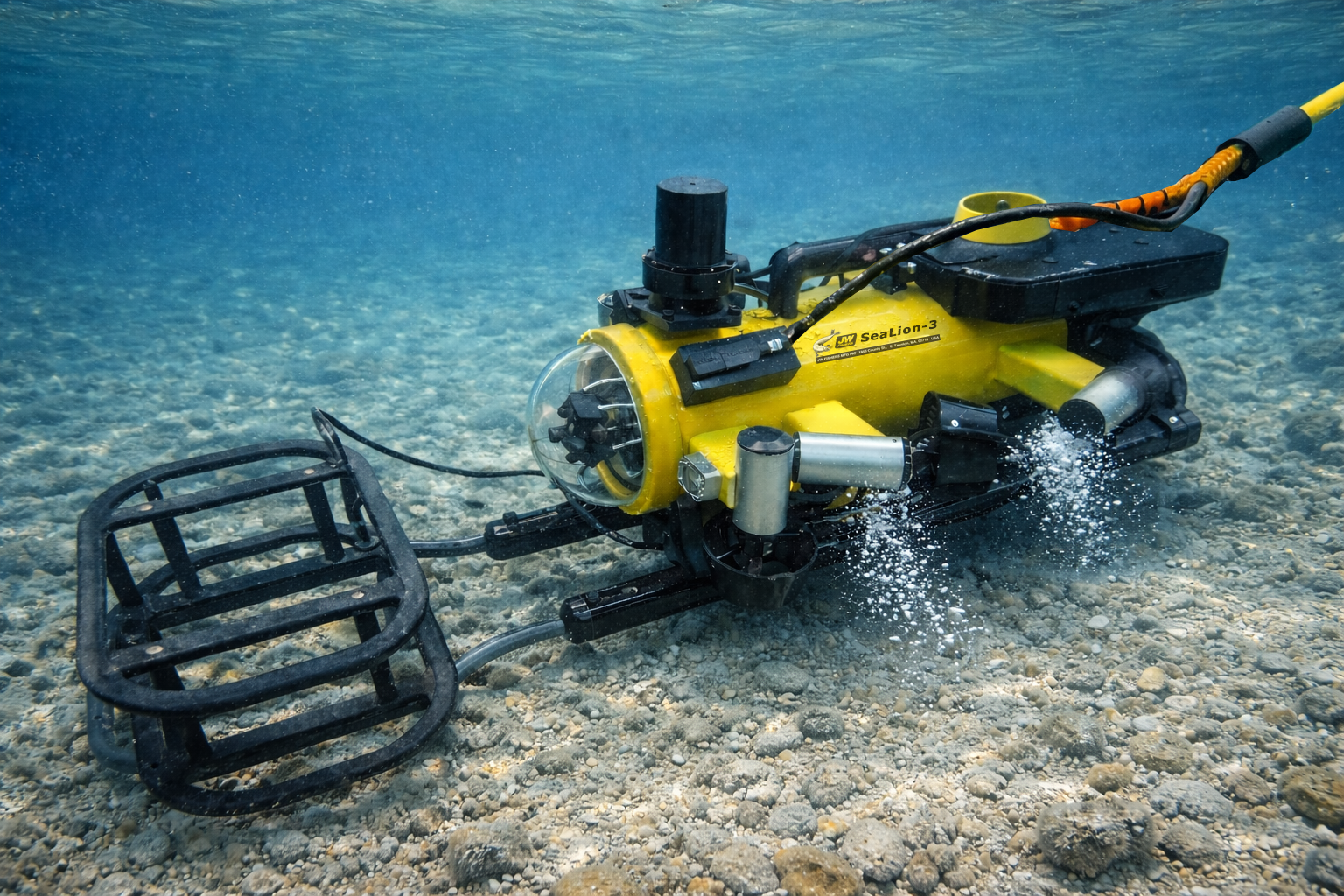
The JW Fishers SeaLion-3 ROV is designed to support public safety, law enforcement, search and recovery teams, and commercial marine operations. Unlike many ROV systems that require costly upgrades, the SeaLion-3 comes standard with a wide range of sensors and capabilities.
Its powerful seven-thruster vectored propulsion system provides exceptional maneuverability and stability, allowing operators to work effectively around bridges, docks, vessels, pipelines, and other underwater structures.
The SeaLion-3 can be equipped with the JW Fishers RMD-1 Metal Detector, enabling operators to locate submerged weapons, evidence, pipelines, anchors, and other metallic targets. Paired with an optional multibeam sonar, the system becomes an invaluable tool for operations in muddy, dark, or zero-visibility water.

High-definition video lets operators inspect and document targets in real time while staying safely on the surface.
When to Use an ROV Instead of a Diver
An ROV is often the better choice when:
- Initial site assessment is required
- Water conditions are unsafe for divers
- Long-duration inspections are needed
- Budget and operational efficiency are priorities
- Evidence or targets must first be located
- Inspections are conducted in low or zero visibility
Many agencies now deploy an ROV as the first response tool and only send divers into the water once a target has been identified.

The Best Solution: ROV and Divers Working Together
Rather than viewing ROVs and divers as competing technologies, the most effective underwater operations often integrate both. An ROV can quickly search large areas, identify targets, assess conditions, and document findings. Divers can then be deployed only when physical intervention or recovery is required.
This approach improves safety, reduces costs, and increases mission success rates.
Conclusion
While divers remain indispensable for many underwater tasks, modern ROVs have transformed how search operations are conducted. Remotely operated vehicles allow organizations to inspect underwater environments faster, safer, and more efficiently than ever before.
For many search operations, the question is no longer "ROV or diver?" but rather "How can an ROV reduce diver risk and improve operational effectiveness?" The answer increasingly points to deploying an ROV first and using divers only when necessary.
Subscribe to our newsletter
Stay up-to-date with the latest news, product updates, and exclusive offers by subscribing to our newsletter.
Related Products